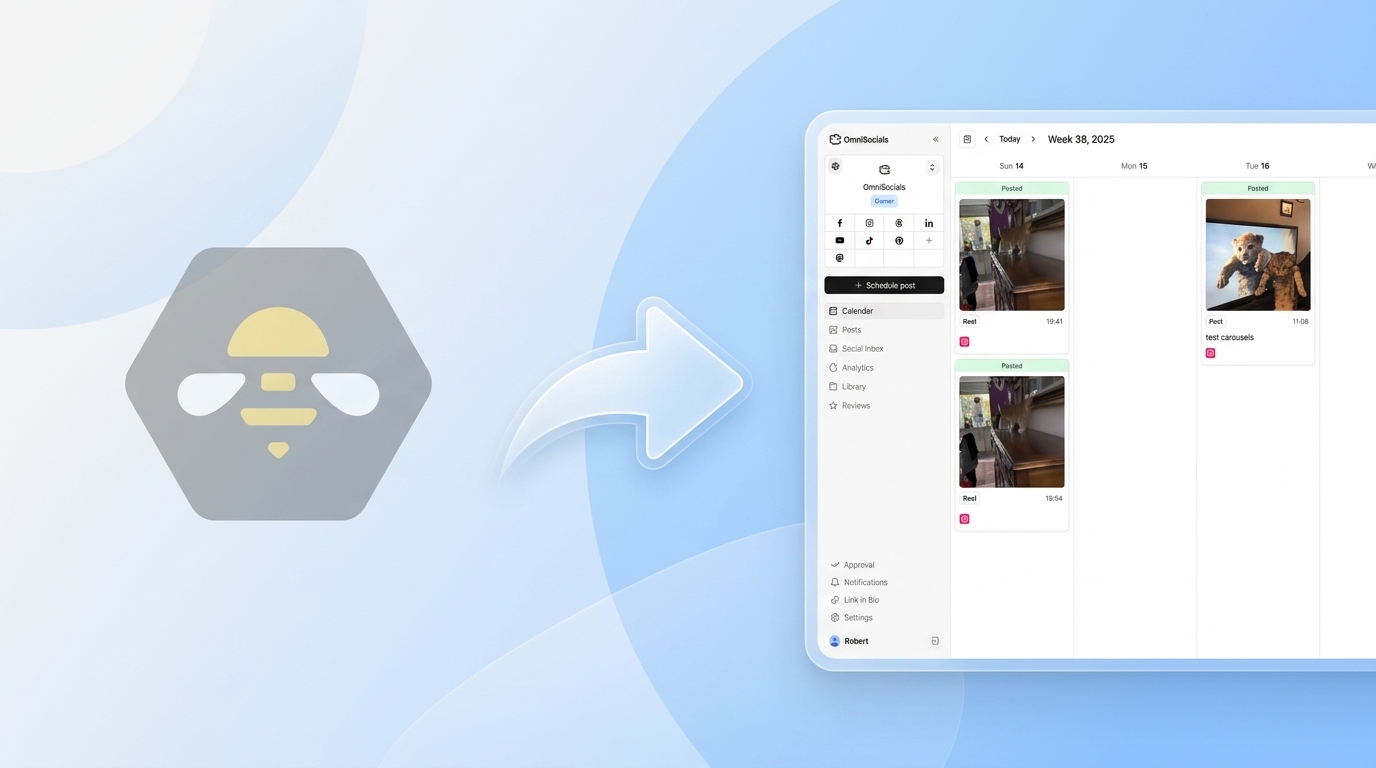
Best Crowdfire Alternatives in 2026 (After the Shutdown)
Crowdfire shut down on May 15, 2025, after 15 years in the social media space.
If you were using it for content discovery, follower management, or scheduling, you need a replacement. The good news is that most of what Crowdfire did, other tools do better in 2026.
I've put together this list of the best Crowdfire alternatives based on what Crowdfire users actually used it for.
Quick picks:
- Best overall replacement: OmniSocials ($10/mo, 11 platforms, flat pricing)
- Best free option: Buffer (free plan for 3 channels)
- Best for Instagram/visual: Later (visual grid planning)
- Best for content recycling: RecurPost (evergreen queue management)
- Best for agencies: Agorapulse (team workflows, inbox, reporting)
What Crowdfire did (and what to look for in a replacement)
Crowdfire was primarily known for three things:
- Content scheduling, queue posts across multiple platforms
- Content discovery, suggest articles and images to share based on your niche
- Follower management, track follows/unfollows, analyze audience growth
Most scheduling tools replace #1 easily. For #2 and #3, it's more nuanced, some tools have content suggestion features, but the follower tracking piece has largely been deprecated across most platforms (X/Twitter API changes made it much harder to offer this).
For most people, the priority is finding a good scheduler that's reliable, affordable, and supports the platforms they care about.
1. OmniSocials: Best overall Crowdfire replacement
OmniSocials is the tool I'd recommend to most former Crowdfire users. It hits the combination of platform breadth, clean workflow, and price that Crowdfire never quite nailed.
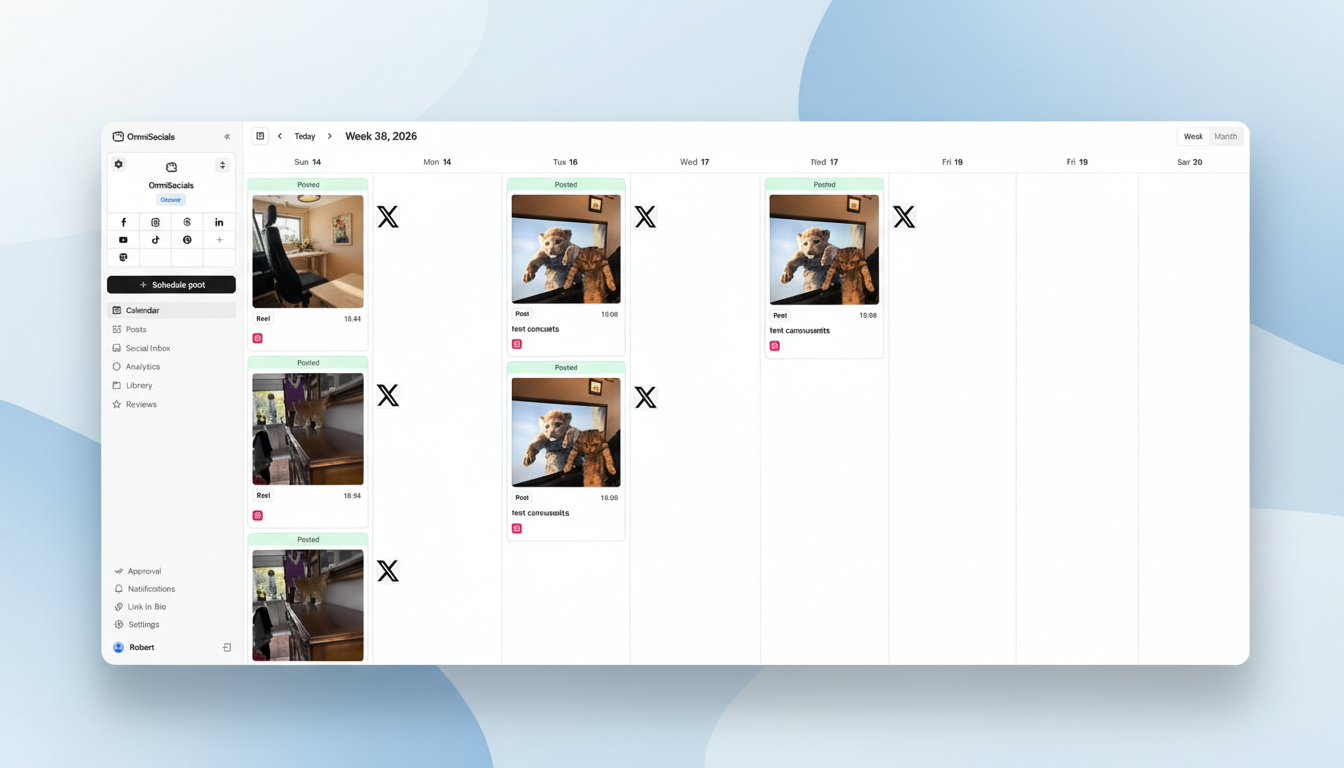
[Screenshot: OmniSocials content calendar with scheduled posts]
Crowdfire's pricing was famously confusing, different tiers with different post limits and platform restrictions. OmniSocials charges a flat $10/mo for everything: 11 platforms, unlimited posts, unified inbox, and media library.
The platforms alone are worth noting. Instagram, Facebook, LinkedIn, YouTube, TikTok, X, Pinterest, Bluesky, Threads, Mastodon, and Google Business Profile. Crowdfire never supported Bluesky or Mastodon.
Key features:
- 11 platform support: broader than Crowdfire ever offered
- Visual post editor: compose and preview before publishing
- Unified inbox: DMs and comments across all platforms
- Content calendar: visual weekly and monthly planning
- Media library: Pexels and Unsplash built in
- Approval workflows: for client review without enterprise pricing
Pros:
- Flat $10/mo: no tier confusion, no per-channel fees
- 11 platforms including Bluesky, Threads, Mastodon
- Unified inbox: something Crowdfire never had
- Clean UI: easier to learn than most alternatives
Cons:
- No content discovery feature: Crowdfire suggested articles to share; OmniSocials doesn't
- No follower tracking: that feature set is largely gone industry-wide
Pricing: $10/mo annual ($12/mo monthly). 14-day free trial.
Verdict: If you used Crowdfire mainly for scheduling, OmniSocials is the most direct replacement. More platforms than Crowdfire ever supported, a unified inbox, and flat pricing at $10/mo.
2. Buffer: Best free Crowdfire alternative
Buffer is the cleanest, simplest Crowdfire replacement, especially if you're coming from Crowdfire's lower-cost tiers.
The free plan covers 3 channels and 10 scheduled posts per channel, enough for most solo users. Paid plans start at $6/channel/month, which is reasonable for small accounts but scales up with channel count.
What I particularly like about Buffer is the zero learning curve. Post composer, pick a time, done. If Crowdfire's interface ever frustrated you, Buffer will feel like a relief.
Pros:
- Free plan for 3 channels
- Simplest interface on this list
- Reliable publishing: Buffer has been around since 2010
Cons:
- Per-channel pricing adds up quickly past 3 channels
- No content discovery
- 8 platforms: no Bluesky or Mastodon
Pricing: Free plan. Essentials from $6/channel/mo.
Verdict: Buffer is the right Crowdfire replacement if you want something free to start and simple to learn. The per-channel pricing becomes an issue past 5 channels.
3. Later: Best for visual content scheduling
Later is the best Crowdfire alternative for creators focused on Instagram, TikTok, and Pinterest.
The visual content calendar with grid preview is genuinely useful for visual-first brands, you see how your Instagram feed will look before any post goes live. Crowdfire's scheduling was functional but never had this visual planning layer.
Pros:
- Visual grid preview for Instagram
- Great media library for organizing content
- Link in Bio built in
Cons:
- Not cheap: Starter $25/mo, Growth $45/mo
- Focused on visual platforms: not ideal if LinkedIn and X are your main channels
- No Bluesky or Mastodon
Pricing: Starter $25/mo, Growth $45/mo, Advanced $80/mo.
Verdict: Later is the right pick if Instagram and TikTok scheduling are your priority. For multi-platform coverage beyond visual channels, other options here do more.
4. Publer: Best for power users
Publer is worth considering if you used Crowdfire's bulk scheduling or automation features heavily. The CSV import and recycling/resharing features cover workflows that Crowdfire users often miss.
Publer supports 9 platforms at $12/mo for the Professional plan. Cheaper than most, and the feature set is solid.
Pros:
- Bulk CSV import: schedule hundreds of posts at once
- Content recycling: reshare top-performing posts automatically
- Affordable at $12/mo entry
Cons:
- No Bluesky or Mastodon
- UI is dated compared to modern tools
- Mobile app is limited
Pricing: Professional from $12/mo.
Verdict: Publer is worth a look if you want something closer to Crowdfire's full feature set at an affordable price. The recycling and auto-scheduling fill a real gap for power users.
5. RecurPost: Best for evergreen content recycling
RecurPost is the Crowdfire alternative to look at if you specifically used Crowdfire for evergreen content recycling, posting the same evergreen content repeatedly on a schedule.
Content libraries let you organize posts by topic, and RecurPost cycles through them automatically. It's the most systematic approach to evergreen scheduling on this list.
Pros:
- Strong evergreen recycling: content libraries with automatic rotation
- Affordable entry at $12/mo
- Analytics included at lower tiers
Cons:
- No Bluesky or Mastodon support
- Less polished UI
- Agency plans get expensive ($79/mo+)
Pricing: Personal $12/mo, Agency from $79/mo.
Verdict: RecurPost is the best Crowdfire alternative for evergreen content management. If you used Crowdfire for content recycling, RecurPost is the most direct replacement.
6. Loomly: Best for team workflows
Loomly is what I'd recommend for small teams that need a shared content calendar with approval steps before publishing.
The post optimization tips and content ideas feed are similar in spirit to Crowdfire's content discovery feature, even if they work differently. Teams that struggled with "what should we post" find Loomly's ideation tools genuinely helpful.
Pros:
- Content ideas feed: calendar holidays, trending topics, awareness days
- Approval workflow: review before publishing
- Clean visual calendar
Cons:
- Base plan ($32/mo) limited to 10 accounts
- No unified inbox on base plan
- 6 core platforms: limited compared to OmniSocials
Pricing: Base $32/mo, Standard $60/mo.
Verdict: Loomly is a solid fit for teams and small agencies that need approval workflows at a reasonable price. Not the best fit for solo users or anyone wanting deep analytics.
7. Agorapulse: Best for agencies
Agorapulse is the full-featured replacement if you were using Crowdfire to manage social media for multiple clients.
It combines a best-in-class unified inbox, content calendar, team permissions, and client reporting in one tool. The price reflects it. Standard is $99/mo for 10 profiles.
Pros:
- Unified inbox: handles all DMs, comments, mentions across platforms
- White-label reports: generate client reports automatically
- Team and client permissions: role-based access control
Cons:
- $99/mo is steep for small teams
- Learning curve on the reporting and inbox features
- Overkill for solo users
Pricing: Standard $99/mo, Professional $149/mo.
Verdict: Agorapulse is the right Crowdfire replacement for agencies managing multiple clients. The unified inbox and white-label reporting are genuinely strong. The price reflects that.
8. Hootsuite: Enterprise alternative
Hootsuite is an option if you need enterprise-grade features, integrations, compliance, social listening, and team management at scale.
For most ex-Crowdfire users, it's probably overkill. At $99/mo for 10 social accounts, the price-to-value ratio doesn't make sense compared to OmniSocials or Buffer.
Pros:
- Massive integrations: Salesforce, Slack, custom workflows
- Enterprise compliance features
- Deep analytics and custom reporting
Cons:
- $99/mo entry price
- Complex interface that takes time to learn
- Primarily for larger teams
Pricing: Professional $99/mo.
Verdict: Hootsuite only makes sense as a Crowdfire replacement for enterprise teams with existing integrations or compliance requirements. For most Crowdfire users, the $99/mo entry price is a poor trade.
Crowdfire vs alternatives: quick comparison
| Tool | Price/mo | Platforms | Inbox | Content Ideas |
|---|---|---|---|---|
| OmniSocials | $10 | 11 | Yes | No |
| Buffer | $6/ch | 8 | No (basic) | No |
| Later | $25 | 7 | Limited | No |
| Publer | $12 | 9 | No | No |
| RecurPost | $12 | 9 | No | No |
| Loomly | $32 | 6 | No | Yes |
| Agorapulse | $99 | 7 | Yes | No |
| Hootsuite | $99 | 10 | Limited | No |
Crowdfire's content discovery feature (suggesting articles to share) hasn't been replicated by any major tool. The closest is Loomly's ideation feed, but it's calendar-based rather than niche-topic based.
For pure scheduling with the best platform coverage and lowest price: OmniSocials.
For the best free option: Buffer.
For agencies that need inbox + reporting: Agorapulse. If you're evaluating Agorapulse specifically, see our Agorapulse alternatives guide for context on where it sits in the market.
If affordability is your primary concern, our affordable social media management tools comparison covers the full landscape at the $10-30/mo range.
Ready to replace Crowdfire? OmniSocials covers 11 platforms for $10/mo →, including Bluesky, Threads, and Mastodon that Crowdfire never supported.
Verdict: Hootsuite only makes sense as a Crowdfire replacement for enterprise teams with existing integrations or compliance requirements. For most Crowdfire users, the $99/mo entry price is a poor trade.
FAQ
Is Crowdfire really shut down? Yes. Crowdfire officially closed on May 15, 2025, after 15 years. The service is no longer available and accounts cannot be accessed.
What's the best free Crowdfire alternative? Buffer offers a free plan for up to 3 social channels. For a paid alternative, OmniSocials at $10/mo is the most affordable option with full features and 11 platforms.
Do any Crowdfire alternatives offer follower management? Follower management (tracking who follows/unfollows you) was one of Crowdfire's features, but it's become largely unavailable industry-wide due to API changes from X/Twitter and Instagram. Most tools have dropped it. Agorapulse has the most robust audience monitoring features if that's important.
Which Crowdfire alternative supports the most platforms? OmniSocials supports 11 platforms including Bluesky, Mastodon, and Threads, more than any other tool on this list. Crowdfire only ever supported the major platforms. See the full OmniSocials vs Crowdfire comparison for pricing and feature details.